
Wright County Projected Versus Actual Release
A projected release date is a planning date based on the sentence and the rules that apply at that point. An actual release date records the physical custody change. The two can differ. A state prisoner’s presumptive parole release date is tentative and depends on institutional behavior and an acceptable release plan. A conditional-release date comes from the sentence structure set by Missouri law, but the Board can extend it through the lawful misconduct process.
A pretrial detainee at Wright County Jail is different. Until the court sets and the person meets release terms, dismisses the case, or enters another order, there is no fixed sentence date to calculate. A bond order gives legal authority for release but does not establish the precise moment the jail processed an exit or transfer. The Sheriff’s movement record supplies that fact.
- PRD
- A presumptive parole release date assigned tentatively by the Missouri Parole Board.
- Conditional release date
- The point when the prison portion of an eligible sentence may give way to supervised release.
- Minimum parole eligibility
- The earliest point for Board consideration, not a release promise.
- Final discharge
- The end of MODOC custody and supervision.
- Detainer
- A request or legal hold that may send a person to another custodian instead of the community.
Find Wright County Projected Release Dates
Start by separating a Wright County jail case from a MODOC prison case. The county jail holds pretrial detainees, people serving county terms, and people awaiting transfer. Its calculation comes from the judgment, jail credit, other holds, and any lawful local sentence method. MODOC calculations apply only when the court commits the person to state corrections or state supervision.
- Read the judgment in Missouri Case.net and identify whether the commitment is to Wright County Jail or MODOC.
- For a jail-only case, call Wright County Jail at 417-741-7576. Ask for the current sentence calculation, credited time, known holds, and the authority used.
- For a state case, open the MODOC Offender Search, note its data-current time, complete the CAPTCHA, and search by DOC number or name.
- Compare identifiers before opening a result. Record only the exact status, sentence entry, office or institution, and release-related label displayed.
- If the public result is unclear, contact MODOC Constituent Services with the full name, correct spelling, DOC number, and date of birth.
- After the projected date, confirm the actual event with the responsible agency rather than assuming the estimate held.
The MODOC landing page documents the live locator’s scope and limits.
Open the official MODOC active-offender search to check its current timestamp and disclaimer.
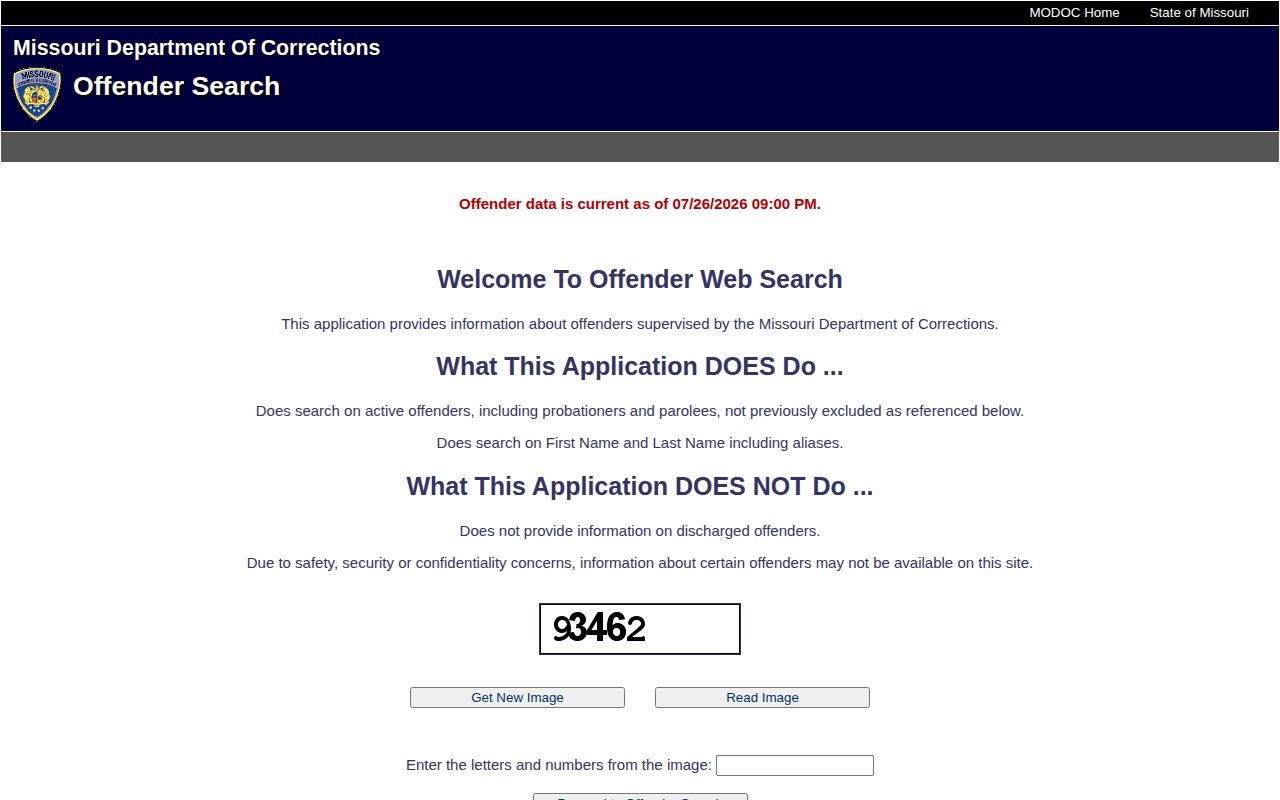
The official screen states that active probationers and parolees can appear, while discharged offenders are excluded.
Note: A Wright County jail-only sentence should never be calculated with the state prison conditional-release formula.
Wright County Jail Release Calculation
No public Wright County jail good-time policy, calculator, weekend-release statute application, or automatic Friday-release practice was verified. That absence matters. A definite misdemeanor term committed to county jail under RSMo § 558.011 is not the same as a felony term committed to MODOC. The jail calculation may depend on the judgment, lawful credit for time already held, concurrent or consecutive cases, and an outside detainer.
Ask the Wright County Sheriff’s records custodian for the actual sentence computation and the authority used for each credit or adjustment. Include the person’s legal name, date of birth or another disambiguator, booking number if known, court case number, sentencing date, sentence length, jail-credit entry, calculated release date, holds, and receiving agency. The Sheriff’s official contact is 125 Court Square, Hartville, MO 65667, phone 417-741-7576. General county counter hours are Monday through Friday, 8:00 a.m. to 4:30 p.m., but those are not proven jail release-processing hours.
The court docket and jail record serve different roles. A judgment controls the sentence. A bond or release order supplies legal authority. Only the jail’s movement record confirms when custody ended or whether the person transferred. The Wright County release-record search path covers the booking and release fields needed after the event.
Missouri Release Dates for Wright County
Missouri state sentences can include several dates that should not be merged. Under § 558.011.4, many felony terms other than dangerous-felony and specified repeat-remand cases contain a prison portion and a conditional-release portion. For an eligible term of nine years or less, the conditional portion is one-third. For a term between nine and fifteen years, it is three years. For a term over fifteen years, it is five years. The prison portion is the balance.
Those ratios do not produce a reliable personal date by themselves. Other sentence types or statutes may displace the default. Jail credit, consecutive or concurrent cases, the date of offense, court corrections, Board action, program needs, detainers, and the real judgment all matter. The Board may also extend conditional release, up to the sentence, through the statutory institutional-violation procedure.
A simple six-year example illustrates the limit: an otherwise eligible term has a one-third conditional-release component, but raw subtraction still cannot establish the person’s actual date. The official sentence computation must incorporate the record and all controlling restrictions. The MODOC glossary defines PRD as a tentative Board date conditioned on suitable conduct and an acceptable release plan.
Wright County 85-Percent Release Rule
The often-cited 85-percent rule is not universal in Missouri. RSMo § 558.019 requires a person committed to MODOC for a “dangerous felony,” as defined in § 556.061, to serve a minimum prison term equal to 85 percent of the imposed sentence. The statute also contains an alternative tied to age 70 after at least 40 percent has been served, subject to its terms.
“Minimum prison term” addresses time before eligibility for parole, conditional release, or another early MODOC release. It does not guarantee release on the first eligible day. Offense classification, prior commitments, the date of offense and sentence, and other specific laws can control. For dangerous-felony or relevant prior-commitment cases, the Parole Board’s procedural Blue Book places hearing scheduling around the minimum term or the normal schedule, whichever is later. Eligibility remains separate from a Board grant and from physical release.
Why Wright County Release Dates Change
A release estimate can move before the day arrives. Some causes arise from the sentence; others come from conduct, court action, or another custodian. A changed date does not by itself show an error. Compare the updated agency record with the judgment and ask for the reason tied to the specific case.
| Factor | Possible effect | Best confirmation |
|---|---|---|
| Institutional conduct | Affects a tentative PRD or permits conditional-release extension under lawful process. | MODOC caseworker or official sentence record |
| Parole Board action | May grant a later date, deny release, modify, or rescind prior action. | Board notice and active MODOC status |
| Sentence correction | Changes the controlling term or jail credit. | Court order and agency recalculation |
| Consecutive cases | One term may follow another rather than run at the same time. | Judgments and official computation |
| Detainer or hold | Can result in transfer to another agency instead of community release. | Releasing agency and receiving custodian |
| Release plan or program | Can delay a tentative parole release when approval or completion is required. | Institutional caseworker or Board notice |
| Revocation or data correction | Can replace an earlier projection or change displayed status. | MODOC record and court or Board documentation |
Note: Disappearance from a current roster can also reflect a transfer or data interruption, so it never supplies a release date by itself.
Wright County Discharged Release Records
MODOC’s public locator explicitly says it does not provide discharged-offender information. That creates a counterintuitive sequence. An active parolee may remain visible after leaving prison because state supervision continues. Once final discharge ends custody and supervision, the person may disappear from the live search. A no-result is therefore not proof that the person was never in MODOC custody or that a particular release date is correct.
Historical verification moves to MODOC records and the court docket. RSMo § 217.075 makes MODOC offender records public under Chapter 610 except medical and other lawfully closed information. Ask for the custody status, release date, release type, supervision start, final discharge date, and the specific document needed. Identify the person with the DOC number and other available details.
For a Wright County jail-only case, request the Sheriff’s booking and release record instead. MODOC cannot produce a county calculation it never made. Case.net may preserve the judgment and disposition after both custody systems stop showing a current person, but the docket is not a physical exit log.
Confirm Wright County Actual Release
After a projected date passes, look for an active parole or field-supervision status on MODOC, an agency release event, and the official custody record. Missouri’s MOVANS portal can provide local jail, court, or MODOC event alerts for eligible registrations, but an alert is not a certified release record. A released event from one source also does not rule out transfer to another custodian.
For a pending Wright County jail event, use the current MOVANS portal and confirm the selected name and agency. Since the May 2026 transition, local-jail registration uses SMS or email rather than the old local-jail phone and VINELink-app channels. The Wright County VINE inmate check explains that one-person registration path. If a result is absent, call the Sheriff because DPS warns that a local jail may be offline.
For state custody, ask the institution’s caseworker or the field probation and parole officer identified on the record. For a historical event, use MODOC Constituent Services or an open-records request. Keep the projected date, legal eligibility date, supervision start, and final discharge as separate fields. That distinction prevents a tentative estimate from being reported as the day the person actually left custody.
Public Record Search
Sponsored Results